 Steven Moody
How to Fix QuickBooks Error 6155, 0: Step-by-Step Recovery Guide
Teknologi | 2026-09-23 05:09:10When opening QuickBooks Desktop to handle daily accounts payable, billing, or payroll, encountering a sudden error dialog can bring business operations to a dead stop. Among the most troublesome issues in the -6000 series family is QuickBooks Error (-6155, 0).
This error indicates that QuickBooks cannot read, verify, or execute the requested connection to your company data file (.QBW). Whether it happens on a standalone desktop or across a multi-user office network, understanding the root cause and following a clear, structured troubleshooting sequence is the fastest way to get your accounting workflow back on track.
This comprehensive guide details what Error 6155, 0 means, common triggers, preparation steps to protect your books, verified solutions, and preventive practices for long-term file health.
What Is QuickBooks Error 6155, 0?
QuickBooks Error 6155, 0 is a database access error that occurs when QuickBooks Desktop tries to open, restore, or verify a company file, but finds that critical installation components, folder permissions, or internal database links are damaged, incomplete, or blocked.
When this error appears, the screen displays a message similar to:
"Error -6155, 0: An error occurred when QuickBooks tried to access the company file."
Or:
"We're sorry, QuickBooks can't open your company file. The file may be damaged or located in a restricted folder. Error (-6155, 0)."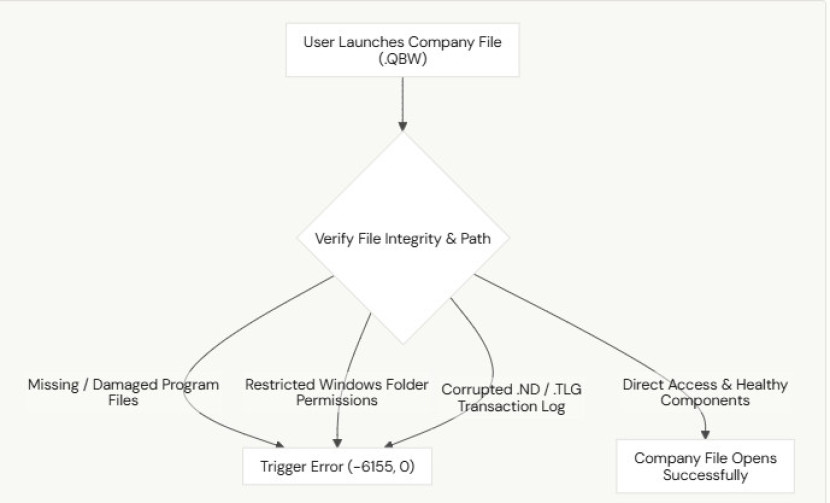
At a technical level, this error means the main program executable (QBW32.EXE) and the database engine (QBDBMgrN) cannot complete a read-write cycle because supporting files in the application directory are damaged, or because Windows security policies block access to the storage folder.
Primary Causes of QuickBooks Error 6155, 0
Knowing what triggers Error 6155, 0 helps you apply the right fix without wasting time on unrelated settings:
- Damaged QuickBooks Installation Files: Incomplete installation files, failed software updates, or corrupted program binaries in the core Intuit directory.
- Corrupted Network and Transaction Files: The Network Data (.ND) and Transaction Log (.TLG) companion files have become out of sync or corrupted following an improper computer shutdown or power outage.
- Restricted Windows Folder Permissions: The Windows user account lacks full read, write, and modify permissions for the folder where the company file resides.
- Active Third-Party Antivirus or Backup Locks: Security software or automated cloud backup utilities (such as OneDrive, Dropbox, or Google Drive) lock database files during background synchronization scans.
- Damaged Company File Architecture: Internal database pointer damage or index corruption inside the primary .QBW working file.
- Opening a Backup File Without Restoring: Trying to double-click and open a compressed .QBB backup or .QBM portable file directly, rather than using the proper in-app restore wizard.
Real-World Business Scenario: The Blocked Morning Billing Run
- The Situation: A mid-sized commercial plumbing supply company stores its primary QuickBooks company file on a shared office computer. On a busy Tuesday morning, the office bookkeeper launched QuickBooks Desktop, selected the company file, and was immediately stopped by: Error -6155, 0: An error occurred when QuickBooks tried to access the company file.
- The Breakdown: The previous evening, an automated Windows update had forced the computer to reboot while QuickBooks was still open in the background. This sudden termination interrupted active write operations, leaving the .ND network data file corrupted and locking write permissions in the company file directory.
- The Solution: The bookkeeper opened the folder holding the company file, renamed the damaged .ND and .TLG configuration files to create fresh versions, and ran the QuickBooks File Doctor through the QuickBooks Tool Hub. The tool corrected the database pointers in under 12 minutes, allowing the billing department to resume invoicing with zero data loss.
Critical Preparation: Protecting Your Accounting Data
Before modifying system files, renaming extensions, or running repair tools:
- Create a Manual Copy of Your File: Open Windows File Explorer, browse to your company file location (typically C:\Users\Public\Documents\Intuit\QuickBooks\Company Files), copy your .QBW file, and paste it into a safe local folder or an external USB storage drive.
- Never Delete Your Transaction Log File: When troubleshooting, always rename companion files rather than deleting them. Adding a .OLD extension preserves historical transaction log markers if deep recovery is ever needed.
- Log In as a Windows Administrator: Make sure you are signed into your computer with full local administrative privileges so that permission changes and file repairs are applied without system blocks.
Step-by-Step Solutions to Fix QuickBooks Error 6155, 0
Follow these troubleshooting steps in sequence, moving from basic file checks to automated repair tools and clean reinstallation.
Step 1: Verify File Type and File Extension
Attempting to launch a backup file directly is one of the simplest and most common triggers of Error 6155, 0.
- Open the folder where your accounting files are stored.
- Check the file extension at the end of your company file name:
- .QBW (QuickBooks Working File): This is the active database file that opens directly.
- .QBB (QuickBooks Backup File): This is a compressed archive. It cannot be opened directly with a double-click.
- .QBM (QuickBooks Portable File): This is a compressed transfer file that must be restored before opening.
- If you are trying to open a .QBB file:
- Open QuickBooks Desktop to the No Company Open window.
- Click Open or restore an existing company.
- Select Restore a backup copy (.QBB), click Next, and follow the on-screen steps to restore the file to a working .QBW format on your local hard drive.
Step 2: Rename Corrupted .ND and .TLG Configuration Files
The Network Data (.ND) and Transaction Log (.TLG) files help QuickBooks connect to your company database. If an improper shutdown corrupts these files, QuickBooks throws Error 6155, 0.
Important: Renaming these files will NOT delete your accounting records.
Your company data lives inside the .QBW file. QuickBooks will generate
a clean, fresh .ND file automatically the next time you open the file.
- Close QuickBooks Desktop completely on all computers.
- Open Windows File Explorer (Windows + E) and navigate to your company file directory:
- Default path: C:\Users\Public\Documents\Intuit\QuickBooks\Company Files
- Locate the files with the exact same name as your company file, but ending with .ND and .TLG:
- Example: CompanyFile.qbw.nd
- Example: CompanyFile.qbw.tlg
- Right-click the .ND file, select Rename, and add .OLD to the end: CompanyFile.qbw.nd.OLD
- Right-click the .TLG file, select Rename, and add .OLD to the end: CompanyFile.qbw.tlg.OLD
- Reopen QuickBooks Desktop and attempt to open your company file. The software will recreate these files automatically.
Step 3: Verify and Adjust Windows Folder Permissions
If your Windows user profile lacks full read/write rights to the storage folder, Error 6155, 0 will appear every time the database engine attempts to write temporary transaction cache files.
- Open Windows File Explorer and navigate to C:\Users\Public\Documents\Intuit.
- Right-click the QuickBooks folder (or the specific custom folder where your .QBW file is stored) and select Properties.
- In the Properties window, click the Security tab, then click Edit.
- In the list of group and user names, highlight Everyone (if missing, click Add, type Everyone, and click OK).
- In the permissions section below, ensure the Allow box is checked for:
- Full control
- Modify
- Read & execute
- Read
- Write
- Repeat this check for the QBDataServiceUserXX account (where XX matches your version year).
- Click Apply, then click OK.
- Switch to the General tab of the Properties dialog, make sure Read-only is unchecked, click Apply, and select Apply changes to this folder, subfolders and files. Click OK.
Step 4: Run Quick Fix my Program and File Doctor via QuickBooks Tool Hub
The QuickBooks Tool Hub consolidates essential diagnostic and repair utilities into an easy-to-use launchpad:
- Close all open programs and QuickBooks windows.
- Download and open the latest build of the QuickBooks Tool Hub (such as build 1.6.0.8).
- From the left-hand navigation pane, select Program Problems.
- Click Quick Fix my Program.
- This utility shuts down background processes, cleans temporary application memory leaks, and fixes broken registry hooks.
- Allow the tool 2 to 3 minutes to run, then launch QuickBooks and test your company file.
- If the error returns, go back to the Tool Hub and click the Company File Issues tab.
- Click Run QuickBooks File Doctor.
- Browse to your .QBW file, enter your company file administrative password, choose Check your file (damage only), and click Next.
- Allow the scan 10 to 20 minutes to complete, then try opening the file again.
Step 5: Perform a Clean Install Using the Clean Install Tool
If Error 6155, 0 persists after repairing permissions and running File Doctor, core application files in your QuickBooks program directory are likely damaged and require a clean reinstallation.
- In the QuickBooks Tool Hub, navigate to the Installation Issues tab.
- Click Clean Install Tool.
- Select your version of QuickBooks Desktop, check the box confirming you are ready to proceed, and click Continue.
- This utility automatically renames hidden installation folders (such as AppData and ProgramData directories) so that old configuration files do not conflict with your fresh installation.
- Open the Windows Control Panel, select Programs and Features, locate QuickBooks Desktop, and click Uninstall.
- Once the uninstallation is complete, restart your computer.
- Reinstall QuickBooks Desktop using your original license number and product code.
- Launch the newly installed program and open your company file.
When to Seek Professional Assistance
While following standard troubleshooting steps resolves most instances of Error 6155, 0, certain deep technical problems require manual database intervention:
- Persistent -6000 Series Cascades: Error 6155, 0 appears alongside errors like -6000, -82 or -6123, 0, pointing to internal database indexing table damage.
- Damaged Company File Headers: The company file refuses to open on any computer, and File Doctor finishes with the message: "File damage cannot be repaired automatically."
- Balance Sheet Out of Balance: The file opens after extensive repairs, but the accrual-basis balance sheet shows assets that do not equal liabilities and equity.
- Corrupted Master Lists: Chart of Accounts, Customer Center, or Vendor registers display blank rows, unreadable characters, or broken transaction links.
Contact the Data Service Team
When automated repair utilities cannot restore your company file or when facing critical business downtime, reach out to specialized recovery experts:
- Support Unit: Data Service Team
- Direct Toll-Free Line: +1-(888)-718-7888
The Data Service Team provides secure database extractions, block-level hex table rebuilds, transaction log restoration, and comprehensive recovery for damaged QuickBooks company files.
Practical Best Practices to Prevent QuickBooks Error 6155, 0
- Avoid Storing Active Files on Cloud Sync Drives: Never run active .QBW working files directly from Dropbox, Google Drive, OneDrive, or Box. These services lock file blocks during background sync cycles, which frequently triggers Error 6155, 0 and file corruption.
- Perform Monthly Data Verifications: Run File > Utilities > Verify Data at least once a month. If minor data discrepancies are detected, run Rebuild Data immediately before pointer damage compounds.
- Always Close QuickBooks Properly: Never force-shutdown your computer or pull power cables while QuickBooks is running. Always close the application via File > Exit to give the database manager time to close open handles cleanly.
- Maintain Reliable Local and Off-Site Backups: Schedule automated, verified backups (.QBB) to secondary physical media or dedicated backup storage so you can recover quickly if hardware fails.
Frequently Asked Questions (FAQs)
What does QuickBooks Error 6155, 0 mean?
QuickBooks Error 6155, 0 is a database connection error indicating that the application cannot read or open the company file because of corrupted companion files (.ND or .TLG), restricted Windows folder permissions, or damaged installation components.
Does Error 6155, 0 mean my accounting data is permanently lost?
No. In most cases, the underlying financial records inside the .QBW file are completely intact. The error is usually triggered by file permission blocks or damaged companion files rather than catastrophic database failure.
Will renaming my .TLG file delete my historical transactions?
No. Renaming the .TLG file only resets the temporary transaction cache. Your complete general ledger and historical data remain stored inside the primary .QBW database file.
Why does Error 6155, 0 happen after a Windows update?
Windows updates frequently reset folder sharing attributes, update local security policies, or require an operating system restart that can interrupt active QuickBooks background services. Readjusting folder permissions and renaming .ND files usually resolves the issue.
Conclusion & Action Plan
QuickBooks Error 6155, 0 can disrupt your accounting workflow, but it is straightforward to resolve with a systematic approach. By verifying file extensions, renaming corrupted .ND and .TLG configuration files, granting full folder permissions to the QuickBooks data directory, and running the diagnostic tools in the QuickBooks Tool Hub, you can clear the error and regain access to your company file safely.
Always keep recent, verified backups of your accounting records and follow proper shutdown procedures to prevent future database locks.
If your company file continues to throw Error 6155, 0, or if diagnostic scans indicate deep structural damage that automated utilities cannot repair, contact the dedicated Data Service Team at +1-(888)-718-7888 for immediate, secure database reconstruction, multi-user optimization, and complete QuickBooks file recovery support.
Disclaimer
Retizen adalah Blog Republika Netizen untuk menyampaikan gagasan, informasi, dan pemikiran terkait berbagai hal. Semua pengisi Blog Retizen atau Retizener bertanggung jawab penuh atas isi, foto, gambar, video, dan grafik yang dibuat dan dipublished di Blog Retizen. Retizener dalam menulis konten harus memenuhi kaidah dan hukum yang berlaku (UU Pers, UU ITE, dan KUHP). Konten yang ditulis juga harus memenuhi prinsip Jurnalistik meliputi faktual, valid, verifikasi, cek dan ricek serta kredibel.