 Laxmikant Mishra
What Happens Inside Guidewire When a Claim Is Registered and Assigned
Eduaksi | 2026-06-08 15:40:05
Whenever a claim is filed in Guidewire, there are so many things that take place behind the scenes. The majority of the users are only aware of the data that is being entered into the software, but actually a lot is going on in the backend. It checks the details, generates records, matches the data, and forwards the claim to the appropriate individual or group. All this assists insurers in managing their claims systematically. Understanding such procedures internally is one of the main reasons that many people opt for Guidewire Training.
The Claim Gets Created
It all begins when the user inputs claim data into the system. This will entail such data as policy information, client information, loss information, contact information, and other necessary data.
Before Guidewire generates the claim, it examines if the information inputted is complete. The system makes sure there are no missing fields and that all essential information is provided. In case a piece of essential information is missing, the user is prompted to provide this information before proceeding further.
Prospective Guidewire Certification test-takers study these verification procedures since they form a key part of the claim process.
When all seems well, the system creates a claim record, which is then used as the central document for storing all subsequent claim information.
What Gets Done First
● Claim details get inputted.
● Required information gets verified.
● Policy information gets confirmed.
● Claim record gets generated.
● System logic runs.
Guidewire Starts Connecting Information
Once the claim is generated, Guidewire starts making relationships between all the relevant pieces of information. This includes relationships between claims and policies, claims and coverages, claims and customers, claims and contacts, and others.
These relations happen in an automated fashion, and users normally do not see them created since they play an important role for the proper functioning of different modules.
The topic of data relationships is discussed in a Guidewire Testing Course due to their importance for testing purposes.
At the same time, Guidewire may initiate some background processes that involve workflow initiation or communication with other systems.
How does the Claim Gets Assigned?
With the creation of the claim, Guidewire identifies its owner or owners. The process of assignment can begin now.
There are criteria, established before within the company, according to which the system makes assignments. Claims are not assigned to anyone at random; on the contrary, some factors are considered first.
Guidewire Functional Online Training participants often get acquainted with such assignment rules because they play a major role in claim processing.
The following and similar factors could be considered:
● Claim type
● Severity level
● Responsibilities of the team
● Workload
● Specifics of business
After all these points are considered, the claim goes to the appropriate user or group.
Main Parts Used During Assignment
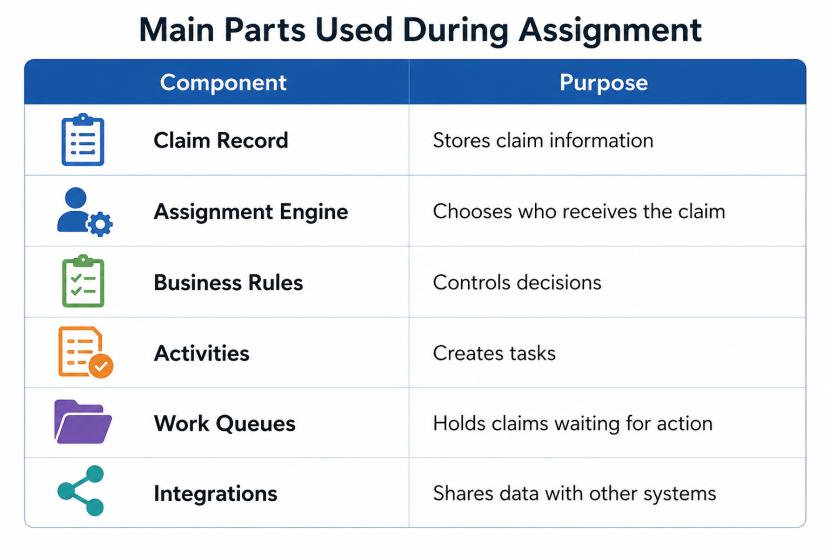
A better understanding of these areas is often gained through Guidewire Training, especially when learning how claims move through the system after registration.
Tasks Are Created Automatically
Once the claim gets assigned, Guidewire begins task creation. The tasks created are referred to as activities.
Activities assist users to understand the type of tasks that need to be done. Tasks will vary depending on company policy and could include review, approval, collection of documents, updating, or investigating.
Unlike manual creation of all tasks, Guidewire does most of it through automation. This subject matter is often found in most Guidewire Certification training because managing activities is quite essential when handling claims.
Guidewire Talks to Other Systems
In fact, most insurance firms use multiple software solutions. This results in the frequent need for communication between Guidewire and other software solutions.
Guidewire may need to provide data to documentation, payments, reporting, and fraud review software solutions.
The importance of communication in a Guidewire Testing Course lies in the need for proper data flow between applications.
Examples of common procedures include the following:
● Transmission of claim data
● Receipt of updates
● Generation of documentation
● Exchange of payment information
● Updating of reports
Incorrect functioning of such communications will affect business processes.
Managing Large Numbers of Claims
These insurance firms might have to attend to several claims daily, which could range from hundreds to thousands. Queues are what Guidewire does to help manage such high levels of tasks.
Queues operate just like waiting rooms in which cases wait until the correct staff can attend to them.
Many learners of Guidewire Functional Online Training learn about the role of queues in assisting organizations in handling such high volumes of claims.
Business Rules Control Everything
Business rules are an integral part of the claims process and assist Guidewire in deciding the next course of action. Rules may be used for validations, assignments, activities, notifications, and much more.
This explains why Guidewire training lays a lot of emphasis on rule concepts within the Guidewire environment. Rule configuration is also a significant consideration within Guidewire Certification because any slight change may impact the flow of claims within the system.
Rule testing is one of the key aspects covered in a Guidewire Testing Course because organizations need to ensure that their claims follow the right procedure. Some participants attending Guidewire Functional Online Training also learn how business requirements are transformed into system rules for insurance operations.
Conclusion
Once a claim is entered into and assigned in Guidewire, more goes on behind the scenes than one may see on screen. This includes things like validation, record creation, record linking, rule application, task creation, and routing the claim to the right department. Communication with other applications and workload management via queues also occur behind the scenes in the process.
Disclaimer
Retizen adalah Blog Republika Netizen untuk menyampaikan gagasan, informasi, dan pemikiran terkait berbagai hal. Semua pengisi Blog Retizen atau Retizener bertanggung jawab penuh atas isi, foto, gambar, video, dan grafik yang dibuat dan dipublished di Blog Retizen. Retizener dalam menulis konten harus memenuhi kaidah dan hukum yang berlaku (UU Pers, UU ITE, dan KUHP). Konten yang ditulis juga harus memenuhi prinsip Jurnalistik meliputi faktual, valid, verifikasi, cek dan ricek serta kredibel.