 Laxmikant Mishra
Become an ERP Expert with Professional Odoo Training
Eduaksi | 2026-05-19 19:11:04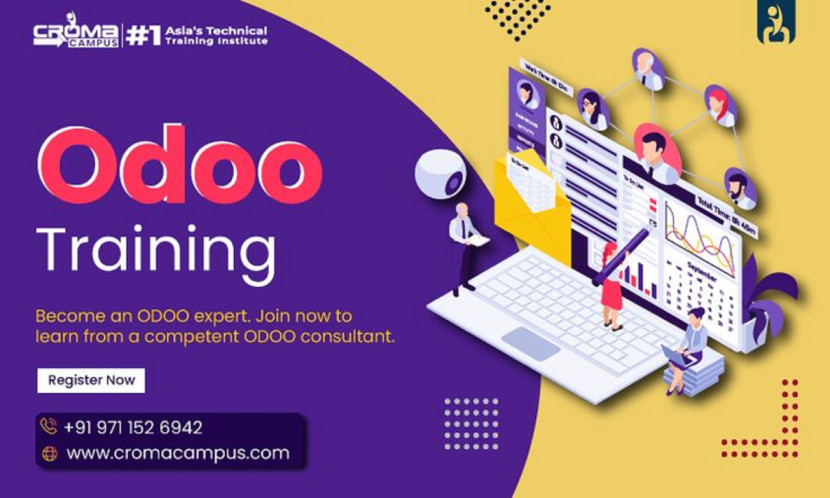
Today, many businesses are using open-source business management software that is very flexible, allowing them to run their companies more efficiently. Many types of open-source software fall under the category of “enterprise resource planning" (ERP); however, one of the largest recognized providers of such software is Odoo. Odoo has an extensive number of business application modules designed to cover a business's operations from "CRM" (customer relationship management) to e-commerce to accounting (financial reporting and accounting) to manufacturing.
Odoo provides a single platform for running the various modules simultaneously and communicating with each other, therefore breaking down many data silos that are prevalent within growing organizations. An Odoo Course will teach you how to use Odoo products by giving you thorough knowledge of how everything in Odoo works together to increase an organization's production.
Architecture and Process Flow
The design of Odoo ERP's overall architecture allows for high system performance while ensuring that both the availability and consistency of the data are maintained. The three tiers of the architecture consist of a database (data storage), a server (business logic implementation), and a user interface (user-accessible front-end).
- Database Layer (PostgreSQL): The database layer provides the primary function of storing all types of business transactions securely, as well as retrieving these transactions at a high rate of speed.
- The Logic Layer of an Application (Example—Python): A logic layer (server-side level coding) provides the location where the business logic for your application occurs; i.e., when a customer buys a product, the server-side code will update the associated inventory record accordingly.
- The Web Layer of Application (Example—JavaScript/OWL): A web layer (client-side interfacing) provides a current, responsive user interface. Web layers provide users (whether working from their desks or on mobile devices) with the means to manage their respective processes.
Strategy Comparison: Deployment Models
Choosing the right infrastructure is a key decision in any implementation project. Professionals who take an Odoo Certification are trained to evaluate these models based on a company’s specific security requirements and budget limitations.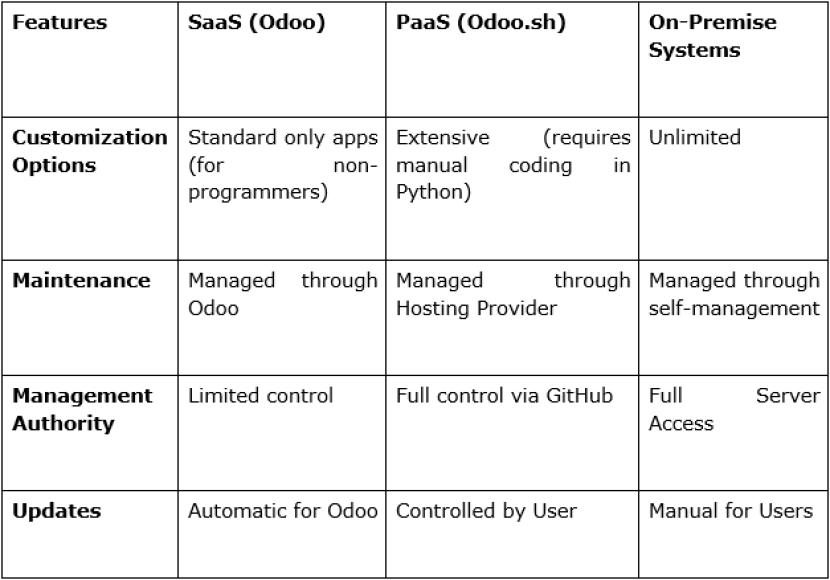
Innovative Automation in Business Management
Today, business processes are not just about collecting data but also learning from it in order to utilize intelligent automated processes. The introduction of built-in AI-enabled tools to convert invoices into digital files (OCR) by scanning the invoices through the vendor's record can provide the user with both the recording and maintenance of these processes to perform automated accounting entries. In addition, businesses can now seamlessly communicate with most other tools in the marketplace (i.e., what tools can they communicate through, etc.) to create the entire automated process from generating a new lead for the business to delivering a physical product to the customer; for example, businesses can now communicate with WhatsApp to notify their customers of an important event, use Stripe to process and transfer money internationally (using any currency), and also have FedEx calculate the exact cost of shipping a package based on its current location and destination.
The Implementation Steps towards Success
- Analysis of the Requirements: Evaluating current processes against the existing modular layout to determine where your organization fits within this framework.
- Configuration of the Environment: Setting up the server and installing any application required, such as Sales/Purchasing/Inventory.
- Transferring Data: Removing any undesired data from your current software or spreadsheet and importing it into your new ERP solution.
- Functional Testing: Running end-to-end scenarios as they would occur on behalf of an end user to ensure all automation (i.e., sending emails, moving stock) occurs as needed.
Conclusion
To obtain a career in the area of ERP, you will need both business logic expertise and technical knowledge of how to manage integrated software solutions. Acquiring your professional certification through an Odoo course will provide you with the essential skills needed to successfully navigate the complexities of digital transformation for current organizations.
By obtaining your educational base in certified ERP software, you will enhance your value to organizations by creating efficiencies for the key operations of that organization. By mastering these tools, you are investing in a career path to excel at automating business processes.
Disclaimer
Retizen adalah Blog Republika Netizen untuk menyampaikan gagasan, informasi, dan pemikiran terkait berbagai hal. Semua pengisi Blog Retizen atau Retizener bertanggung jawab penuh atas isi, foto, gambar, video, dan grafik yang dibuat dan dipublished di Blog Retizen. Retizener dalam menulis konten harus memenuhi kaidah dan hukum yang berlaku (UU Pers, UU ITE, dan KUHP). Konten yang ditulis juga harus memenuhi prinsip Jurnalistik meliputi faktual, valid, verifikasi, cek dan ricek serta kredibel.