 QB BOOKKEEPING EXPERTS
How to Set Up Paid Time Off in QuickBooks for Accurate Payroll
Agama | 2026-09-04 00:19:37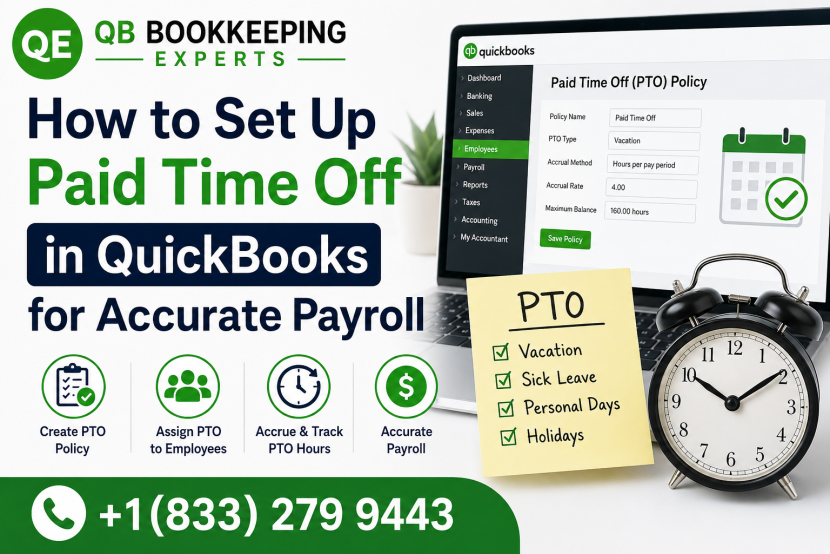
When you understand how to setup paid time off in QuickBooks Online, it will help businesses to run its functionalities in simplified manner. Whether it is manage payroll accurately, keeps track of employee leave utilization and more importantly, stay compliant with their company policy. This guide covers QuickBooks paid time off tracking and explains how to manage QuickBooks PTO set up policies, track employee balances, and avoid payroll errors, whether you are tracking PTO in QuickBooks timesheets, on paper, or with another method.
Key Takeaways
l Ensure accurate employee payroll through correct Set up Paid Time Off (PTO) .
l As per company policy, vacation, sick leave, and personal time are configured.
l QuickBooks payroll utilization helps in tracking PTO balances automatically.
l Prevent payroll errors by reviewing PTO reports on regular basis.
l Maintain compliance and boost employee satisfaction by following best practices.
Introduction
Paid Time Off (PTO) is not just an employee benefit; it forms a large chunk of your payroll management too. You will require sufficient data regarding your vacation, sick leave, and personal leave balances since employees need them tracked correctly while employers want to maintain accurate records for payroll processing and comply with labor law.
The good news is that QuickBooks Online Payroll has features that can help you manage PTO within the platform seamlessly. When appropriately configured the software can automatically calculate accruals, show available balances and populate paid leave into payroll calculations.
Unfortunately, a lot of business owners set up PTO incorrectly— or not at all. This leads to incorrect leave balance for employees, erroneous payroll calculations and HR teams investing their valuable time in manual correcting.
In this guide, we'll show you how to set up paid time off in QuickBooks, why it matters and how you can take advantage of a few key features inside QuickBooks to simplify payroll by enhancing employee confidence.
Table of Contents
1. What Is Paid Time Off in QuickBooks?
2. Why Should You Set Up PTO?
3. Common Signs Your PTO Setup Needs Attention
4. How Incorrect PTO Setup Affects Business
5. How to Set Up Paid Time Off in QuickBooks Online
6. Best Practices for QuickBooks Paid Time Off Tracking
7. Real Business Case Example
8. Expert Tips
9. Why Choose Quick Bookkeeping Expert?
10. Frequently Asked Questions
11. Wrap Up
What Is Paid Time Off in QuickBooks?
Paid Time Off (PTO) means paid time off for employees to use for vacation, illness, personal appointment or other approved absence while continuing to pay normal wages.
Employers can customize PTO policies based on their leave structure using QuickBooks Payroll. Businesses can configure depending upon their payroll subscription:
l Vacation hours
l Sick leave
l Personal leave
l Floating holidays
l PTO accrual rules
l Employee leave balances
QuickBooks paid time off tracking, when configured, automatically tracks hours earned and used so there is less manual calculating during payroll.
More tips:- Update QuickBooks Payroll Tax Table
Why Should You Set Up Paid Time Off?
Each business has build its own strategy to manage employee leaves. Some offer a set number of vacation hours per year, while others let employees earn PTO over time via accrual.
Setting up PTO ensures that:
l Payroll includes paid leave correctly.
l Employees can view available balances.
l HR avoids manual calculations.
l Managers approve leave with confidence.
l Payroll complies with company policies.
If your setup is not accurate, then it causes payroll errors to multiply as quickly as possible, especially as your workforce is growing.
More tips:- QuickBooks Error 17337
Common Signs Your PTO Setup Needs Attention
Although PTO is not configuredly correctly still QuickBooks won’t show an error, but some warning signs will be there to indicate your settings need to be reviewed.
These include:
l Employee PTO balances appear inaccurate.
l Vacation hours are not included in payroll.
l Sick leave calculations differ from company policy.
l Payroll reports show inconsistent leave balances.
l Employees dispute remaining vacation hours.
l Manual PTO adjustments are required every pay period.
If these issues occur regularly, reviewing your QuickBook PTO setup can save significant time.
How Incorrect PTO Setup Affects Business
Improper PTO configuration affects more than payroll.
Suppose No accurate tracking of vacation hours,either employees may receive underpayments or overpayments. As a result both the situations need to create unnecessary payroll corrections and consequently reduce employee reliability.
Businesses may also experience:
l Payroll processing delays
l Compliance concerns
l Increased HR workload
l Employee dissatisfaction
l Incorrect labor cost reporting
l Critical year-end reconciliations
PTO tracking accuracy supports both financial reporting and workforce planning.
More tips:- QuickBooks Payroll Support Number
How to Set Up Paid Time Off in QuickBooks Online
Here are few steps available those help in configuring paid time off in QuickBooks Online.
Step 1: Enter into Payroll Settings
Login to QuickBooks Online.
Directed to:
Settings - Payroll Settings
Find the Time Off section.
Step 2: Allow Paid Time Off
Turn on Paid Time Off tracking.
You can create separate categories for:
l Vacation
l Sick Leave
l Personal Leave
Each category will have its own accrual rules.
Step 3: Build PTO Policies
Describe how employees are earning leaves.
Common methods include:
l Annual allocation
l Monthly accrual
l Hours worked
l Pay period accrual
Select the strategy that matches your company handbook.
Step 4: Open to Accrual Rules
Configure:
l Hours earned
l Maximum balance
l Carryover limits
l Waiting periods
l Maximum annual accrual
Automatically these settings control QuickBooks paid time off accrual .
Step 5: PTO Assigned to Employees
Open each employee profile.
Under Payroll Information, assign the correct PTO policy.
Each employee has different leave rules as per employement type or tenure. No two employees have same leave rules.
Step 6: Payroll Calculations Review
Run a sample payroll.
Verify:
l PTO hours appear correctly.
l Leave balances update.
l Employee earnings include paid leave.
l Payroll taxes calculate accurately.
Testing before processing live payroll helps prevent costly corrections.
Step 7: Track PTO Reports
Get useful reports from QuickBooks such as:
l Employee Leave Balance
l Payroll Summary
l Paid Time Off Report QuickBooks
l Payroll Detail Report
Diagnose discrepancies as early as possible by reviewing all these reports on regular basis.
More tips:- How to resolve QuickBooks Error 1006
More tips:- How to fix QuickBooks Error 1006
Managing Employee Time-Off Requests
QuickBooks Time is utilized for scheduling by many businesses.
So, employees can:
l Submit there QuickBooks Time Off Requests
l View available PTO balances
l Track approved leave
l Receive manager approval
In the same way, employees also using request time off through QuickBooks Workforce, making leave management faster and more transparent.
Best Practices for Accurate PTO Tracking
Follow these steps to improve your payroll accuracy:
l Check on PTO balances monthly.
l Update leave policies annually.
l Communicate PTO rules clearly.
l Train payroll administrators.
l Audit payroll reports before each payroll cycle.
l Back up payroll records regularly.
l Carryover balances review at year-end.
If you follow these habits , these will not only reduce payroll discrepancies but also improve employee confidence.
Real Business Case Example
In Florida, a marketing agency with its 68 employees shifted from manual spreadsheets to QuickBooks Online Payroll.
Early, HR staff spent approximately 10 hours every payroll cycle calculating vacation balances and correcting leave requests. As a result, frequently employees questioned remaining PTO as spreadsheets were updated manually.
But after implementing QuickBooks paid time off tracking, the agency build separate policies for vacation and sick leaves, assigned accrual schedules, and allowed employee self-service through QuickBooks Workforce.
As a result in three months,
l Payroll preparation time dropped by 35%.
l PTO-related employee inquiries decreased by 60%.
l Payroll corrections were reduced to fewer than two per month.
l Improved process provides accurate labor cost reporting for project budgeting.
More tips:- QuickBooks Error 1722
Expert Tips
QuickBooks professionals have recommend the following tips to maintain accuracy:
l Create written PTO policies before configuring payroll.
l Prevent changing accrual rules at the time of an active payroll period.
l After running every payroll review employee balances.
l Leave manual spreadsheets and use QuickBooks reports.
l Train managers on leave approval procedures.
l Update payroll software to access the latest payroll improvements.
If you want to maintain accuracy in payroll throughout the year then be consistent on your reviews.
Quick Bookkeeping Expert Can Help
The time spent setting up PTO properly the first time prevents payroll mistakes and saves valuable time. Quick Bookkeeping Expert create custom plans for businesses that make Quickbooks paid time off setup as well as implement QuickBook PTO setup, perform a check on the payroll time off lists, incorporate accrual of QuickBooks paid time off accural and improve Quickbooks payroll workflows.
Whether you are setting PTO for a new business or improving an existing payroll system, expert guidance makes sure accurate payroll and leave management.
Know More
Tricks to set up your sales setting.
Know how to setup your advanced settings in QB Online.
FAQs
1. How do I set up paid time off in QuickBooks Online?
In Payroll Setting, select Time Off, create PTO policies, configure accrual and assign to employees. If you find any problem while setting up paid time off then seek professional help at live chat QuickBooks support.
2. Can QuickBooks automatically calculate PTO?
Yes. With QuickBooks Payroll, you can set your own policy, and the software will automatically calculate how much vacation days, sick leave or any other type of paid leave an employee accrues.
3. Does QuickBooks track employee PTO balances?
Yes. The PTO balances in QuickBooks are maintained and cleared automatically after every payroll. Want to know in detail about this employee tracking then discuss everything at QuickBooks desktop support phone number 24 7.
4. Can employees request time off in QuickBooks?
Yes. That means businesses utilizing QuickBooks Time and Workforce to let employees put in and check time-off queries electronically.
5. What reports are available for PTO?
The payroll reports, leave balance reports and paid time off reports provided by QuickBooks help in monitoring the amount of employee leave taken.
6. Can different employees have different PTO policies?
Yes. Specific PTO policies can be assigned according to employee roles, tenure or employment status.
Wrap Up
Understanding how to set up paid time off in QuickBooks is important for a more accurate payroll, less manual work, and being happier employees. Configuring PTO policies, enabling QuickBooks paid time off tracking, reviewing, accrual reports and adhering to payroll best practices will not only allow businesses to manage leaves efficiently but it can also help you minimize payroll errors.
Periodic review of my PTO settings means employees are getting the PAID TIME OFF benefits they need, payroll is compliant and the business runs more smoothly all year round.
Disclaimer
Retizen adalah Blog Republika Netizen untuk menyampaikan gagasan, informasi, dan pemikiran terkait berbagai hal. Semua pengisi Blog Retizen atau Retizener bertanggung jawab penuh atas isi, foto, gambar, video, dan grafik yang dibuat dan dipublished di Blog Retizen. Retizener dalam menulis konten harus memenuhi kaidah dan hukum yang berlaku (UU Pers, UU ITE, dan KUHP). Konten yang ditulis juga harus memenuhi prinsip Jurnalistik meliputi faktual, valid, verifikasi, cek dan ricek serta kredibel.