 Laxmikant Mishra
The Truth About Pega Guardrails and Why You Should not Ignore Them
Eduaksi | 2026-06-02 13:26:27
When people start working on Pega projects, most of the focus goes towards building flows, creating forms, adding integrations, and making the application work fast. Very few people pay attention to guardrails in the beginning. During Pega Training, many learners see guardrail warnings on the screen but treat them like normal notifications. Later, they realize those warnings were actually pointing towards real technical problems.
Pega Guardrails are there for one reason. They help developers build applications in the right way. They keep the system clean, stable, and easier to manage later. In small projects, ignoring guardrails may not create immediate problems. But in large business applications, even small mistakes slowly become serious issues.
What Pega Guardrails Actually Do?
Pega Guardrails are built-in checks inside the platform. They review the way developers create rules and processes. If something is not following recommended practices, the system shows a warning.
These checks mainly look at things like:
- Rule design
- Database usage
- Performance
- Security
- Reusability
- Memory handling
- Upgrade support
The platform does not show these warnings without reason. Every warning is connected to some technical risk.
For example, if developers use too much custom code, the system may become difficult to upgrade later. If report queries are not optimized, performance becomes slow when users increase.
During Pega Certification Training, learners slowly understand that guardrails are not there to disturb development work. They are there to stop future problems before they grow bigger.
Why Many Developers Ignore Them?
The biggest reason is deadlines.
Most project teams work under pressure. They want quick delivery. Developers often use shortcuts because they think fixing warnings can be done later.
Sometimes fresh developers also do not fully understand the impact of those warnings. If the application is running properly, they assume everything is fine.
But technical problems in Pega usually grow slowly.
At first, the system may work normally. After some months, users start noticing delays. Reports become slower. Debugging becomes harder. Deployments take more time.
In many projects covered under Pega CSA Course, teams later discover that old shortcuts created most of the maintenance problems.
Ignoring guardrails is similar to ignoring small cracks in a building wall. They may not look dangerous immediately, but they grow over time.
How Guardrails Affect Performance?
One such field in which guardrails are important is Performance.
The Pega platform is built in a way that everything works fine when developers code using conventional approaches. In addition to having its own optimization tools, Pega does not like extra customization by developers.
Some typical problems are:
- Big clipboard pages
- Excessive activities
- Repeatedly calling databases
- Overburdening the reports
- Duplicate logic
- Extra looping
These all contribute to higher system loads.
In Pega Course for Beginners, it is often observed that students only concentrate on case creation and UI section creation. It can help learners understand performance-related guardrails before even writing any application.
Applications scoring better on guardrails generally perform well even under heavy loads.
Common Guardrail Problems in Real Projects
The table below shows some common problems developers create while building applications.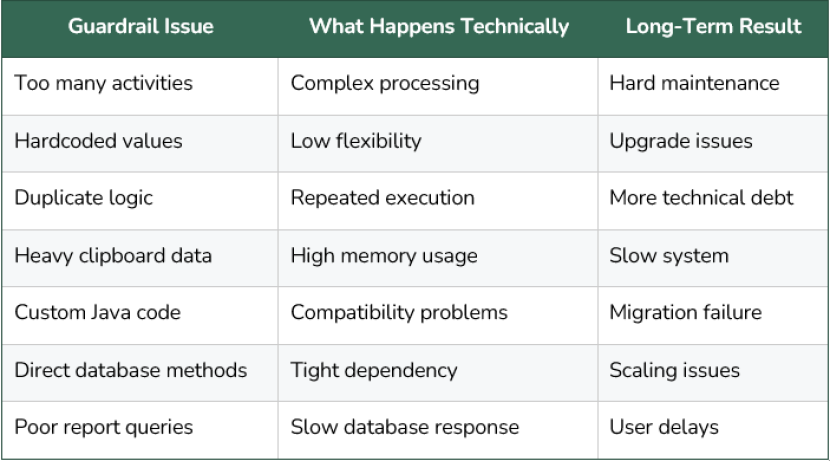
Most of these problems are avoidable if developers follow standard practices from the beginning.
Why Guardrails Matter During Upgrades
This is one area where many teams face trouble.
Pega platforms keep changing with new updates, security improvements, and better features. Applications built using proper standards usually move to newer versions smoothly.
But heavily customized applications become difficult to upgrade.
Sometimes one small custom logic breaks after migration. Then teams spend weeks fixing old code.
During professional Pega training, developers learn that clean architecture is more important than quick shortcuts.
Good guardrail compliance helps with:
- Easier upgrades
- Faster deployments
- Better testing
- Stable releases
- Less production issues
That is why architects take guardrail reports seriously during enterprise reviews.
Why Are Guardrails More Important in Cloud Systems?
Today most Pega applications run on cloud platforms. Cloud systems handle large amounts of users, APIs, and background jobs together.
Weak design becomes visible very quickly in cloud environments.
Poor guardrail practices can create the following:
- Slow API response
- Queue delays
- High memory usage
- Node instability
- Session failures
Under Pega Certification Training, learners understand how small mistakes become bigger under heavy user traffic.
For example, a report that works fine during testing may become very slow in production when thousands of users access it together.
Guardrails help reduce these risks early.
Why Fresh Developers Should Learn Guardrails Early
Many fresh developers think guardrails are only for architects or senior developers. That is not true. Learning guardrails early builds strong technical habits.
Conclusion
Pega Guardrails are one of the most crucial elements of Pega development, yet there is a common disregard for them by most users. These alerts do not come from nowhere; rather, they signal technical risks in the application. Any shortcuts may prove to be efficient at the moment yet cause problems with performance, upgrades, and further maintenance in the future. By following guardrails, it becomes easier for developers to develop an application that will be capable of supporting the company in the future.
Disclaimer
Retizen adalah Blog Republika Netizen untuk menyampaikan gagasan, informasi, dan pemikiran terkait berbagai hal. Semua pengisi Blog Retizen atau Retizener bertanggung jawab penuh atas isi, foto, gambar, video, dan grafik yang dibuat dan dipublished di Blog Retizen. Retizener dalam menulis konten harus memenuhi kaidah dan hukum yang berlaku (UU Pers, UU ITE, dan KUHP). Konten yang ditulis juga harus memenuhi prinsip Jurnalistik meliputi faktual, valid, verifikasi, cek dan ricek serta kredibel.