 Mark John
How to Repair the Windows Installer Service Before Reinstalling QuickBooks
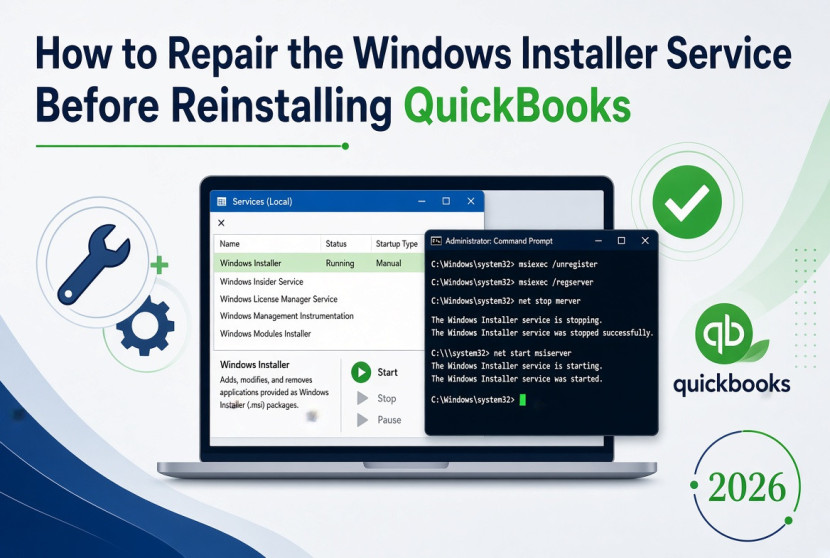
Teknologi | 2026-09-17 19:01:22To repair the Windows Installer service before reinstalling QuickBooks, first confirm the service itself is running (not stopped or disabled), then re-register the Windows Installer engine using msiexec /unregister and msiexec /regserver from an elevated command prompt. If installs still fail after that, running a Windows System File Checker scan addresses deeper file-level corruption the re-registration alone won't fix.
Here's the full process, in the order that actually resolves the most cases first.
Prefer to have this handled for you directly? Call +1-866-408-0444.
Why This Matters Before You Reinstall QuickBooks
If the Windows Installer service itself is broken, reinstalling QuickBooks won't help — every installer error you're seeing (including registry permission errors like Error 1406) can trace back to a Windows Installer problem rather than anything specific to QuickBooks. Fixing this first means your next QuickBooks installation attempt actually has a working foundation to run on.
Step 1: Confirm the Windows Installer Service Is Running
- Press Windows + R, type services.msc, and press Enter.
- Scroll to Windows Installer in the list.
- Right-click it and select Properties.
- Set Startup type to Manual if it isn't already.
- Click Start if the service isn't currently running, or Restart if it is.
If the service fails to start and shows a specific error code, that code points to a more targeted issue — worth searching for that exact code rather than continuing with general steps.
Command-line alternative: Open an elevated Command Prompt and run net start MSIServer.
Step 2: Re-Register the Windows Installer Engine
If the service runs but installations still fail, the MSI engine itself may have lost its registration with Windows.
- Open an elevated Command Prompt (right-click Start, select Terminal (Admin) or Command Prompt (Admin)).
- On 64-bit Windows, run each of these commands in order, pressing Enter after each:
%windir%\system32\msiexec.exe /unregister %windir%\system32\msiexec.exe /regserver %windir%\syswow64\msiexec.exe /unregister %windir%\syswow64\msiexec.exe /regserver
- Restart your computer.
- Attempt the QuickBooks installation again.
On 32-bit Windows, you only need the two system32 commands above.
Step 3: Run the Microsoft Program Install and Uninstall Troubleshooter
Microsoft provides a dedicated troubleshooter specifically for install/uninstall issues tied to the Windows Installer service. Download it directly from Microsoft's official support site and run it before your next QuickBooks installation attempt — it automatically detects and repairs several common Windows Installer issues beyond what manual re-registration addresses.
Step 4: Run System File Checker for Deeper Corruption
If the service runs and re-registration didn't resolve the issue, underlying Windows system file corruption may be the actual cause.
- Open an elevated Command Prompt.
- Run: sfc /scannow
- Allow the scan to complete fully — this can take several minutes.
- Restart your computer and attempt the QuickBooks installation again.
If SFC reports issues it couldn't fix, running DISM /Online /Cleanup-Image /RestoreHealth beforehand and then repeating the SFC scan often resolves what SFC alone couldn't.
Step 5: Verify the MSIServer Registry Path Is Correct
In rarer cases, the registry entry pointing to the Windows Installer executable itself becomes incorrect.
- Open Registry Editor and navigate to HKEY_LOCAL_MACHINE\SYSTEM\CurrentControlSet\Services\MSIServer.
- Confirm the ImagePath value correctly points to [Drive]:\Windows\System32\Msiexec.exe /V, where [Drive] is your Windows installation drive.
- Correct it if it doesn't match, then restart the Windows Installer service.
Always export this key as a backup before making any change, in case you need to revert.
If you've worked through all of this and QuickBooks still won't install, call +1-866-408-0444 rather than continuing to troubleshoot Windows-level issues without a clear diagnosis — at that point, a more thorough system-level assessment is usually faster than continuing to test individual fixes.
When Reinstalling Windows Installer Itself Is the Last Resort
Fully reinstalling the Windows Installer component is rarely necessary and should only be considered after the steps above have been exhausted, since it's a more invasive change to your system than the targeted fixes here. Running the SFC scan first is important specifically because it can resolve the underlying corruption that would otherwise make even a fresh Windows Installer reinstall fail the same way.
Frequently Asked Questions
Is it safe to run the msiexec re-registration commands?
Yes — this only re-registers the existing Windows Installer engine and doesn't modify or delete any files, making it low-risk to try early in troubleshooting.
Does this fix work the same way on Windows 10 and Windows 11?
Largely yes, though re-registration is somewhat less consistently effective on newer Windows versions than it was on older ones — if it doesn't resolve the issue, move on to the SFC scan rather than repeating it multiple times.
Do I need to do this every time I install software, or just when there's a problem?
Just when there's a problem — a working Windows Installer service doesn't need regular maintenance under normal circumstances.
Can a broken Windows Installer service affect programs other than QuickBooks?
Yes — since it's a core Windows component, any software using an MSI-based installer can be affected, which is a useful way to confirm whether the issue is Windows-side rather than QuickBooks-specific.
Still can't get QuickBooks to install after repairing the Windows Installer service? Call +1-866-408-0444 and we'll help finish the job.
Disclaimer
Retizen adalah Blog Republika Netizen untuk menyampaikan gagasan, informasi, dan pemikiran terkait berbagai hal. Semua pengisi Blog Retizen atau Retizener bertanggung jawab penuh atas isi, foto, gambar, video, dan grafik yang dibuat dan dipublished di Blog Retizen. Retizener dalam menulis konten harus memenuhi kaidah dan hukum yang berlaku (UU Pers, UU ITE, dan KUHP). Konten yang ditulis juga harus memenuhi prinsip Jurnalistik meliputi faktual, valid, verifikasi, cek dan ricek serta kredibel.